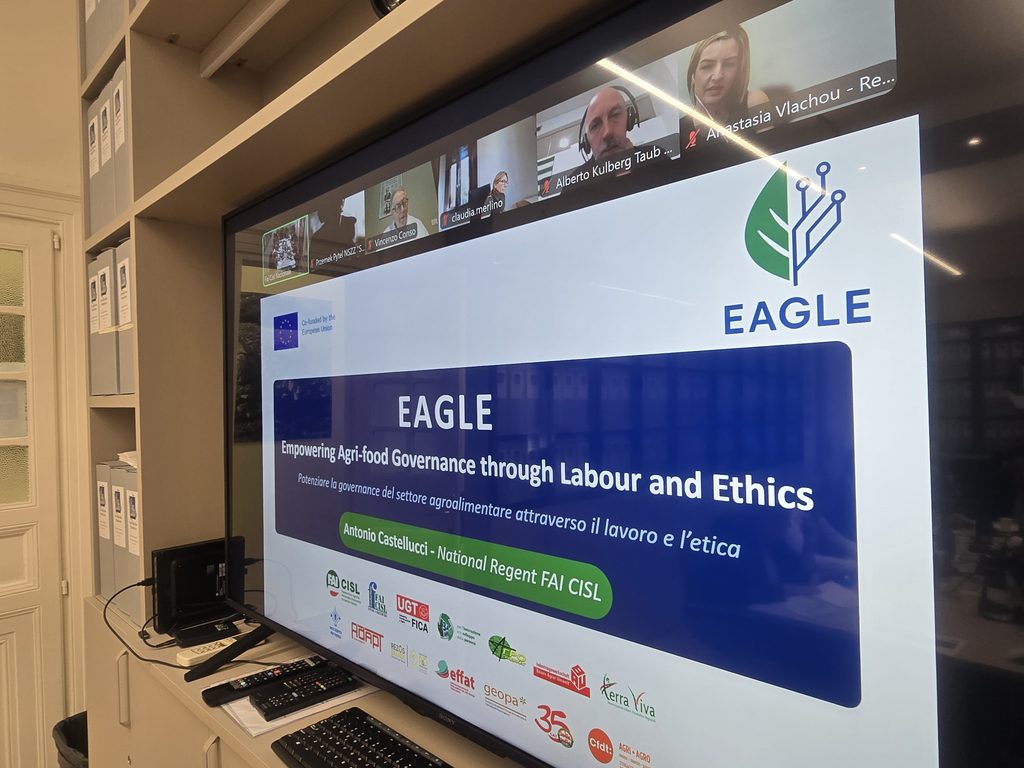
“Strengthening governance in the agri-food sector through labor and ethics by promoting the ethical and socially responsible use of AI”: A video conference was held today from the national headquarters of Fai Cisl, in the Paolo Frascella Room, the kick-off meeting for the European EAGLE project—an acronym for “Empowering Agri-food Governance through Labor and Ethics to Promote the Ethical and Socially Responsible Deployment of Artificial Intelligence”—an EU-funded initiative coordinated by FAI CISL with the participation of various organizations and associations, such as the FAI CISL Studies and Research Foundation (Italy), UGT FICA (Spain), AGROSINDIKAT (North Macedonia), NFAN PODKREPA (Bulgaria), IG BAU (Germany), Terra Viva (Italy), the 3A Association (Italy), Solidarność (Poland), CFDT Agri (France), and the European federations EFFAT and GEOPA-COPA, as well as ADAPT (Italy) for scientific and legal consulting, and Rezos Brands (Greece) for the technical development of the database and website.
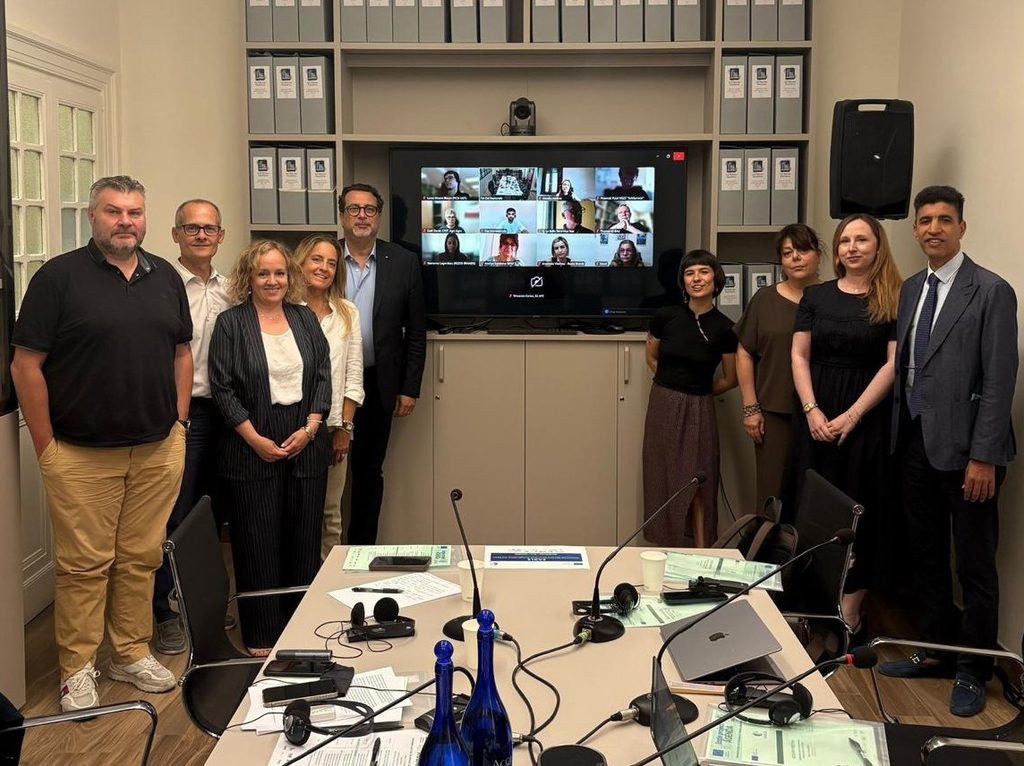
Fai Cisl Regent Antonio Castellucci opened the proceedings: “The project,” he said, “is important first and foremost for affirming the fundamental role of social dialogue in protecting workers’ rights during the technological transition. We face enormous challenges, in which it is important to address the risk of technological unemployment and bridge the digital skills gap. These are emerging issues in agriculture, the food industry, and other sectors within our purview For the union, it is important to govern AI through regulations, collective bargaining, and social dialogue. The real challenge lies in understanding how to govern it and how to ensure that the benefits of innovation are distributed equitably, while avoiding inequalities and new forms of social exclusion. We need a vision that puts the individual worker at the center and views technology as a tool in the service of human development—not the other way around. There is no such thing as work on one side and Artificial Intelligence on the other: they are not two separate realms; AI itself is human labor that produces algorithms, data inputs, and organizational models. That is why we need innovative tools in the realm of collective bargaining as well.”
“The union,” added Castellucci, “can and must take on a new leading role by providing training to make the most of the opportunities offered by new technologies—for example, to better track supply chains, combat and prevent irregular employment, illegal hiring practices, and the underground economy, and to promote productivity, quality of work, and health and safety in every workplace. For FAI, this is a challenge to establish a new model of industrial and labor-union relations, in which we must place the individual and worker participation at the center.”
“The EAGLE project,” concluded the FAI CISL Regent, “is also an opportunity for study, analysis, and refinement of the union’s work to take concrete action. The project represents a first step, with FAI proudly leading a pilot initiative that we intend to be a trailblazer—to invest in continuous training, in higher-quality work, to secure greater corporate social responsibility, greater social cohesion, and the ethical use of technology. This initiative is consistent with the many other efforts undertaken by FAI in the context of European projects and relations with the European trade union and similar organizations in other countries, always with an eye toward a Europe that is not perceived as a distant reality, but as a concrete space in which to build rights, protections, and new opportunities for the agri-food sector.”
Among the representatives of the partners, Claudia Merlino, President of Geopa-Copa—the EU employers’ group of professional agricultural organizations—spoke, emphasizing the organization’s strong interest in actively participating in the project. Merlino highlighted the serious problem affecting most farms: the labor shortage. The President also pointed out that “the risk of not finding workers and witnessing such a rapid digital and technological transition is misleading: on the one hand, it leads one to believe that labor can be replaced by artificial intelligence; on the other, that such rapid technology can offer real solutions, even in the absence of the specific skills needed to manage and govern it.” Social dialogue, Merlino reiterated, “must be a genuine tool for guaranteeing and protecting workers, because the regulation of the labor market cannot be left solely to the market: we hear daily statements on issues related to the digital transition, statements that, however, are not followed by strategies; therefore, the hope is for the establishment of rules.” In conclusion, Merlino stated that she is “convinced that the EAGLE project can help the European Union steer European policies toward truly prioritizing human capital.”
“Funded by the European Union. Views and opinions expressed are however those of the author(s) only and do not necessarily reflect those of the European Union or European Research Executive Agency (REA). Neither the European Union nor the granting authority can be held responsible for them. Grant Agreement No 101262606”
© 2026 Created by Rezos Brands S.A.